 BTC$74,671
 ETH$2,078
 BNB$686.41
 XRP$1.06
 SOL$84.94
 TRX$0.3171
 HYPE$73.11
 ZEC$1,003
 XMR$585.78
 DOGE$0.0686
What are altcoins? Types, risks and how to evaluate them
What are altcoins? Types, coin vs token, and 7 steps to evaluate one. On Nov. 11, 2026, altcoins made up 40.2% of the $2.5T crypto market cap.

Contents
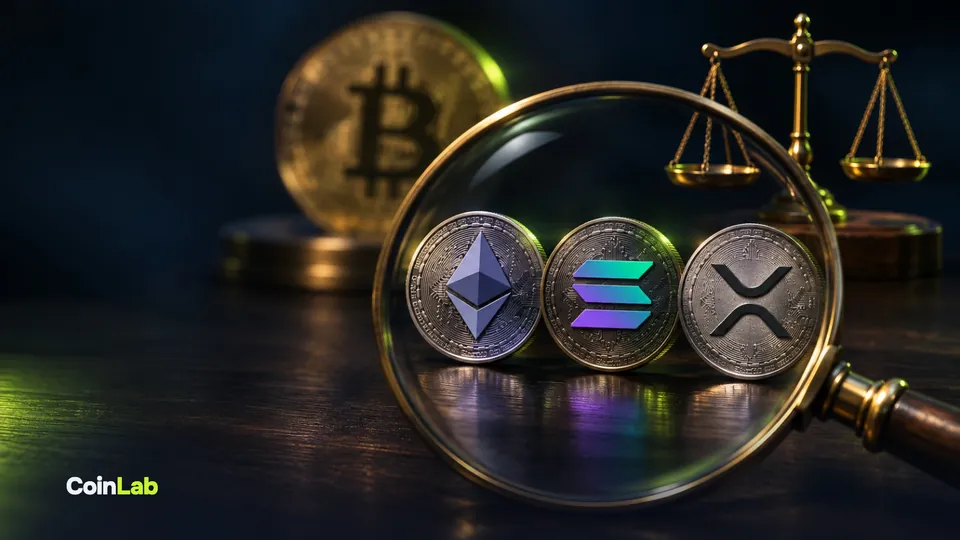
Altcoins are all cryptocurrencies other than bitcoin: ether, Solana, XRP, stablecoins, exchange tokens, memecoins and thousands of lesser-known coins. The word blends "alternative" and "coin." According to CoinGecko data, the aggregator tracked 22,606 active cryptocurrencies on Nov. 11, 2026, and every one except bitcoin is an altcoin. Together they made up about 40% of the crypto market, roughly $1 trillion of $2.5 trillion. A beginner should judge an altcoin not by its price per coin but by five things: what the project does, its market cap, how many tokens are still to be released, how liquid trading is and who holds the supply.
Below: what altcoins are, the main types, how many survive, and a step-by-step way to check a coin using live numbers from November 2026.
What are altcoins and where did they come from?
Bitcoin launched in January 2009 with open-source code, so anyone can copy it, change the parameters and start a new network (the original is covered in What is bitcoin?). That is how the early altcoins appeared. Namecoin was released on April 18, 2011, forked from bitcoin's software and built as a decentralized domain name system with the same 21 million cap, according to Wikipedia. Litecoin was published on Oct. 7, 2011, by former Google engineer Charlie Lee, with a block every 2.5 minutes instead of 10, an 84 million cap and a different mining algorithm, scrypt, its Wikipedia entry says.
Altcoins then stopped being "bitcoin with different settings." Ethereum added smart contracts, programs that run on the blockchain, and exchanges, lending protocols and stablecoins grew on top of them. We compare the two in Ethereum vs bitcoin.
One open question is whether ether and stablecoins count. Formally they do, since neither is bitcoin. In practice, altcoin season indexes include ether but leave out stablecoins and wrapped tokens: CoinMarketCap says Tether and WBTC are excluded while Ethereum is counted as an altcoin.
Coin vs token: what is the difference?
This is the first thing to find out about any altcoin.
- A coin is the native asset of its own blockchain. It pays network fees and rewards those who secure the chain: ETH on Ethereum, SOL on Solana, LTC on Litecoin.
- A token is an entry in a smart contract on someone else's blockchain. It has no network of its own. The most common standard is ERC-20, proposed by Fabian Vogelsteller in November 2015: per ethereum.org, the contract tracks balances, transfers tokens and reports total supply.
The practical point: issuing a token is far easier than launching a blockchain. That is why there are millions of tokens, and why a contract can have owners with special powers, such as minting more supply, freezing an address or changing the logic. For a coin, ask who secures the network. For a token, ask who controls the contract.
Types of altcoins
There is no single classification, but the market usually sorts altcoins by where demand for them comes from.
| Type | Examples | Source of demand | Main risk |
|---|---|---|---|
| Smart contract platforms | ETH, SOL, TRX, ADA, SUI | Network fees, staking, apps | Rival chains, outages, supply inflation |
| Stablecoins | USDT, USDC | Dollar payments and savings | Issuer reserves, frozen addresses |
| Payment coins and bitcoin forks | LTC, BCH, XRP, XLM | Transfers | Weak demand for similar features |
| Privacy coins | XMR, ZEC | Private transfers | Exchange delistings, regulatory pressure |
| Exchange tokens | BNB, LEO | Fee discounts, buybacks and burns | Dependence on one company |
| DeFi and infrastructure tokens | UNI, LINK, HYPE | Protocol governance, share of fees | Hacks, token unlocks |
| Memecoins | DOGE, SHIB | Community attention | No cash flow, sharp crashes |
Stablecoins sit apart in this table: they aim to hold $1, not to rise. See USDT vs USDC for how the two largest work, and What is DeFi for the protocols behind DeFi tokens.
How many altcoins are there, and how many survive?
There is no exact number; it depends on who is counting. CoinGecko showed 22,606 active cryptocurrencies on Nov. 11, 2026, and those are coins that passed the aggregator's listing review. Count every token that ever traded on a decentralized exchange and the figure runs into the tens of millions.
Most of them no longer trade. A CoinGecko study published Jan. 11, 2026, found that 53.2% of cryptocurrencies listed on GeckoTerminal between July 1, 2021, and Dec. 31, 2025, had stopped trading, about 13.4 million tokens. Of those, 11.6 million (86.3%) died in 2025 alone, and roughly 7.7 million in the fourth quarter of 2025. The authors link the surge to launchpads where a token can be created in minutes, mostly memecoins. Only tokens with at least one trade were counted, so the true failure rate is higher.
European regulators put the risk bluntly. In a joint warning dated March 17, 2022, ESMA, the EBA and EIOPA said consumers "face the very real possibility of losing all their invested money."
What the altcoin market looked like on Nov. 11, 2026
Per our data as of Nov. 11, 2026, 1:00 PM ET, total crypto market cap was $2.50 trillion and bitcoin dominance was 59.8%. That left altcoins with 40.2%, about $1.0 trillion. But that sum is far from uniform:
- ether: 10.2% of the market, about $255 billion;
- stablecoins: $291.2 billion, roughly 11.6%;
- all other altcoins combined: about $459 billion, or 18.4%.
In other words, "risk" altcoins excluding ether and stablecoins were worth less than a third of bitcoin alone ($1.50 trillion). Bitcoin itself traded near $74,514 at that point, 40.9% below its $126,080 high of Oct. 6, 2025. The Fear and Greed Index read 29 ("fear"), and the Blockchain Center altcoin season index stood at 33 against a threshold of 75. Live readings are in the Pulse block of our dashboard.
CoinGecko data from the same afternoon shows how large altcoins looked in that phase:
| Asset | Market cap | Market cap / FDV | From all-time high | 1 year |
|---|---|---|---|---|
| Bitcoin (BTC) | $1,495.7B | 1.00 | −41.0% | −28.0% |
| Ether (ETH) | $255.1B | 1.00 | −57.8% | −40.0% |
| XRP | $67.8B | 0.64 | −70.7% | −56.0% |
| Solana (SOL) | $50.4B | 0.93 | −71.0% | −46.9% |
| Hyperliquid (HYPE) | $17.7B | 0.25 | −24.6% | +86.5% |
| Dogecoin (DOGE) | $10.8B | 1.00 | −90.6% | −60.8% |
| Chainlink (LINK) | $8.1B | 0.77 | −80.1% | −33.4% |
| Cardano (ADA) | $6.7B | 0.84 | −94.2% | −68.6% |
| Sui (SUI) | $3.5B | 0.41 | −84.2% | −59.4% |
Two observations. First, most large altcoins had fallen further from their highs than bitcoin, and Dogecoin and Cardano never returned to their 2021 peaks. Second, altcoins do not move in formation: over the same year HYPE gained 86.5% and the privacy coin Zcash rose 103.1%. "Altcoins" describes thousands of different assets, not one market. Current prices are on our ether and Solana pages.
How to evaluate an altcoin: 7 steps for beginners
There is no formula for an altcoin's fair price. There are checks that filter out the weakest candidates.
- What the project does and who pays for it. State in one sentence why the token is needed. For a network it is user fees, for an exchange token the exchange's revenue, for a memecoin only attention. If there is no answer, there is nothing to value.
- Look at market cap, not the coin's price. CoinGecko defines market cap as price multiplied by circulating supply. Dogecoin cost $0.069 on Nov. 11, 2026, but with 156.7 billion coins in circulation its market cap was $10.8 billion. A cheap coin is not an undervalued one.
- Compare market cap with FDV. Fully diluted valuation is the price multiplied by the entire future supply. Hyperliquid had 239.4 million tokens circulating out of 1 billion: a $17.7 billion market cap against a $70.3 billion FDV, a ratio of 0.25. CoinGecko calls tokens with a ratio below 0.5 low float; in May 2024 they were 64 of the top 300, or 21.3%. The remaining tokens reach the market on a schedule, and Binance Research estimated in May 2024 that about $155 billion of tokens would unlock between 2024 and 2030. That is selling pressure unless demand grows just as fast.
- Find out who holds the tokens and how supply grows. Team, fund and early-investor allocations, the unlock schedule and the inflation rate are all in the project's documentation. The more supply sits with a small group, the more the price depends on their decisions.
- Check liquidity. A high market cap does not guarantee you can sell. LEO had an $8.5 billion market cap but only about $1.4 million in 24-hour volume on Nov. 11, 2026; Dogecoin had $388 million. Look at volume, the number of exchanges and depth, which we explain in our guide to the crypto order book.
- Check the team, the code and the incident history. Is the code open, has it been audited or hacked, who can change the contract? Common fraud patterns are collected in how to spot crypto scams.
- Measure against bitcoin, not the dollar. An altcoin only makes sense as a separate position if it beats BTC over a long stretch. The table above shows how rarely that happens in a falling market.
Common mistakes
- "It costs cents, so it has room to grow." Price per coin says nothing without the supply. Shiba Inu cost $0.0000045 with a $2.6 billion market cap.
- Looking only at market cap. A low market cap to FDV ratio means most of the tokens have yet to reach the market.
- Treating altcoins as one market. A stablecoin, an exchange token and a memecoin differ more than a stock and a bond.
- Waiting for altcoin season on a calendar. Altseason indexes describe the past 90 days and promise nothing about the next.
- Sending on the wrong network. The same token exists on several blockchains; a transfer on the wrong one can mean lost funds.
- Trusting yield advertising. EU regulators specifically warn about misleading ads on social media and promises of fast returns.
FAQ
Is Ethereum an altcoin? Formally yes: any cryptocurrency other than bitcoin is an altcoin, and CoinMarketCap counts Ethereum as one in its altcoin season index. Given its size and role, ether is often analyzed separately from the rest of the market.
How many altcoins are there? CoinGecko tracked 22,606 active cryptocurrencies on Nov. 11, 2026. Counting every token on decentralized exchanges, the number is in the millions, and by CoinGecko's count more than half have stopped trading.
Why are altcoins riskier than bitcoin? Thinner liquidity, deeper drawdowns and heavier dependence on a team and an unlock schedule. On Nov. 11, 2026, bitcoin was 41% below its high, while Cardano and Dogecoin were down more than 90%.
What is altcoin season? A period when most large altcoins outperform bitcoin. CoinMarketCap defines it as 75% of the top 100 coins beating BTC over 90 days.
This is not investment advice.

Comments