 BTC$65,043
 ETH$1,828
 BNB$595.58
 XRP$0.9701
 SOL$72.45
 TRX$0.3049
 HYPE$67.70
 ZEC$908.55
 XMR$499.86
 DOGE$0.0597
Real world assets tokenization: what RWA is and how it works
Real world assets tokenization explained: how bonds, funds and gold move on-chain, a $39.5B market as of Nov 15, 2026, top products, benefits and key risks.

Contents
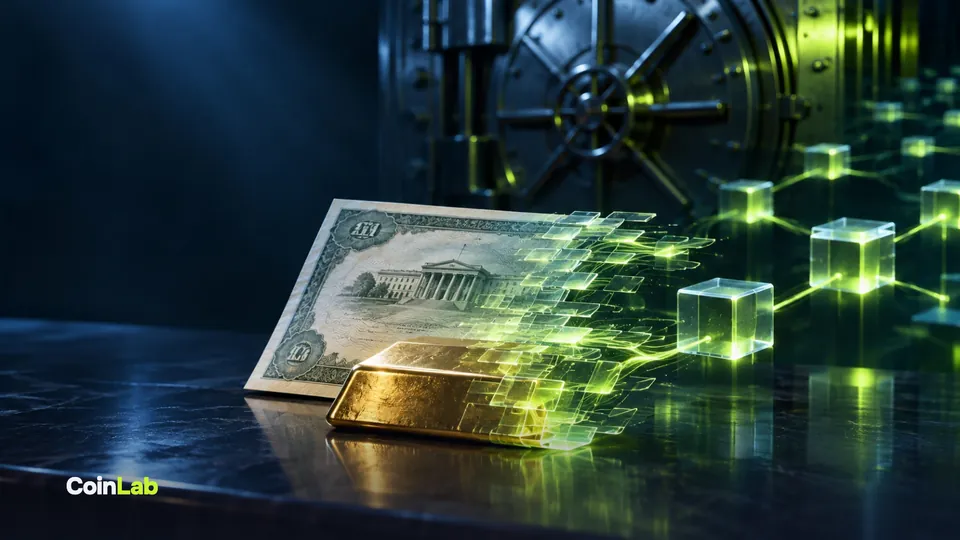
Real world assets tokenization means issuing blockchain tokens that carry a claim on an ordinary off-chain asset: Treasury bills, fund shares, stocks, gold or loans. The asset itself sits with a custodian or issuer, while the token acts as a digital record of ownership that can move in minutes, serve as collateral in DeFi and pay yield straight to a wallet. As of November 15, 2026, real-world asset (RWA) tokens that investors can hold directly in their own wallets totaled $39.5 billion, according to rwa.xyz.
What are real world assets (RWA) in crypto?
A blockchain natively tracks only its own assets: bitcoin, ether and tokens created by smart contracts. Tokenization connects it to the outside world. A company buys, say, short-term US Treasuries, keeps them with a bank custodian and issues tokens, each representing a slice of that portfolio. When a holder sells or redeems a token, the on-chain record changes and the legal claim follows it.
What tokenization does not do is turn a bond into a cryptocurrency. In a staff statement dated January 28, 2026, the US Securities and Exchange Commission said the format of a security "does not affect application of the federal securities laws." A stock on a blockchain is still a stock, a fund share is still a fund share, and every issuer and investor rule still applies.
How tokenization works, step by step
Most products follow the same pattern. Here is the path of a typical tokenized Treasury fund:
- Legal wrapper. A fund or special purpose vehicle (SPV) is set up to own the assets and owe obligations to token holders.
- Asset purchase. Investor cash buys Treasuries, repo or other securities, held by a traditional custodian.
- Investor onboarding. Buyers pass KYC/AML checks and their wallets are added to an allowlist.
- Minting. A smart contract mints tokens to that wallet. Many issuers use standards with built-in rules such as ERC-3643, which checks before every transfer whether the recipient is verified and eligible to hold the security.
- Yield. Interest shows up either as a rising token price or as extra tokens. BlackRock's BUIDL fund, per its Securitize page, accrues dividends daily and pays them the following business day as new BUIDL tokens.
- Redemption. The holder returns tokens for dollars or a stablecoin, and the tokens are burned.
Issuers usually keep manual controls. The ERC-3643 site states that authorized agents can freeze a wallet, pause the token and force a transfer when legally required, and can move a lost wallet's position to a new address tied to the same verified identity. That is the key difference from bitcoin: an RWA token is a permissioned asset that the issuer controls.
Distributed vs represented: two kinds of tokenized assets
Data platform rwa.xyz splits the market into two layers. Distributed tokens are those investors hold in their own wallets and can transfer on-chain. Represented tokens use the blockchain only as a record-keeping layer for financial firms, with no on-chain investor transfers.
The second layer is far bigger: $421.7 billion versus $39.5 billion for distributed assets as of November 15, 2026, per rwa.xyz. Nearly all of it is $374.1 billion in repurchase agreements recorded on the Canton network through the Broadridge DLR platform. Retail investors cannot touch that layer, so the rest of this guide focuses on distributed tokens.
Distributed RWAs by asset class as of November 15, 2026 (rwa.xyz):
| Asset class | Value | What it is |
|---|---|---|
| US Treasury debt | $13.91B | Tokenized money market and short-term bond funds |
| Commodities | $5.10B | Mostly tokenized gold |
| Active strategies | $4.74B | Actively managed funds |
| Stocks | $3.70B | Tokenized equities and ETFs |
| Asset-backed credit | $3.54B | Loans secured by assets |
| Specialty finance | $2.57B | Trade finance, business lending |
| Corporate credit | $1.68B | Company bonds and loans |
| Private equity | $1.55B | Private fund interests |
The tokenized Treasury market as of November 15, 2026
Tokenized Treasuries are the easiest segment to understand. The rwa.xyz Treasuries dashboard showed 123 products worth $13.9 billion as of November 15, 2026, with 86,314 holders and an average 7-day yield of 3.58% annualized. The segment shrank 5.3% over 30 days.
The largest products on the same dashboard:
| Token | Issuer | Value | Minimum / access |
|---|---|---|---|
| USDY | Ondo | $2.38B | non-US investors only |
| USYC | Circle | $2.02B | $100,000 |
| iBENJI | Franklin Templeton | $1.71B | — |
| BUIDL | BlackRock | $1.65B | $5M, qualified purchasers |
| BENJI | Franklin Templeton | $1.28B | $20 |
Ondo's USDY page says the token is available to non-US individuals and institutions and is backed by short-term Treasuries and bank deposits. Minimums come from the rwa.xyz product listings and the Securitize page; for BUIDL, Securitize lists different minimums for different chains in different tables, so the fund documents are the only reliable source.
Where these tokens live: Ethereum leads distributed RWAs with $15.13 billion, or 38% of the market, followed by BNB Chain ($6.20 billion), Solana ($5.13 billion), Stellar ($4.66 billion) and Avalanche ($1.39 billion), per rwa.xyz as of November 15, 2026. More on the leading network on our Ethereum page.
For context, rwa.xyz tracks stablecoins separately, at $277.4 billion on the same date. They are also "dollars on a blockchain," but typically pay holders no interest; we compared the two biggest in USDT vs USDC. RWAs have also been far calmer than crypto: bitcoin was down 14.5% over the week as of the morning of November 15 (see our market pulse), while distributed RWAs moved −1.7% over 30 days.
Why tokenize? The benefits
- 24/7 settlement. Tokens move on weekends and overnight. In an October 8, 2026 blog post, the International Monetary Fund noted that more than half of tokenized-asset trading happens outside traditional market hours.
- Fractional ownership. The same IMF post says around 80% of the tokenized equity trades it analyzed were smaller than one share.
- Yield for crypto markets. Exchanges, funds and DeFi protocols hold reserves in tokenized Treasuries instead of non-yielding stablecoins and post them as collateral. Our guide What is DeFi explains how those protocols work.
- Transparency. Supply, holders and transfers are visible on-chain in real time.
- Market infrastructure is building it. It is not just crypto firms: US depository DTCC launched its tokenization service in October with 34 securities at launch.
Risks and limitations
- You trust an intermediary, not the chain. The blockchain only guarantees the record. Whether the bonds are really at the custodian depends on audits, reports and the law. The SEC's January statement warned that with third-party tokenization, holders face risks owners of the underlying security do not, such as the third party's bankruptcy, and that token rights may differ materially from the security's rights or not convey them at all.
- Issuers can freeze tokens. Allowlists, freezes and forced transfers are standard features of standards like ERC-3643.
- Jurisdiction and investor-status gates. Many products exclude US residents or, conversely, admit only qualified purchasers with multi-million-dollar minimums.
- Liquidity. The IMF says tokenized markets are currently less liquid and more volatile than traditional ones and, as they scale, could amplify fire sales and liquidity runs. We covered the IMF report on tokenization risks in detail.
- Technical risk. Smart-contract bugs, bridge exploits and compromised admin keys still apply.
Common mistakes
- Confusing an RWA token with a platform's coin. A tokenized Treasury fund and the governance token of the platform issuing it (ONDO, for example) are different assets: the first tracks bonds, the second trades like any volatile cryptocurrency.
- Treating the yield as risk-free. Token yield is the fund's return minus fees, with intermediary, smart-contract and redemption risk layered on top.
- Buying a "tokenized stock" without reading the terms. It may be the share itself, a claim on a custodian, or a synthetic derivative. The SEC distinguishes these models and flags the difference in holder rights.
- Using unofficial token copies. Verify the contract address on the issuer's website, not through a DEX search.
FAQ
Can retail investors buy tokenized Treasuries? Yes, with caveats. Some products start small (BENJI from $20, per rwa.xyz), others are limited to non-US investors or to qualified purchasers. KYC is almost always required.
How are RWAs different from stablecoins? A stablecoin holds a $1 price and usually pays holders nothing. A tokenized Treasury fund grows in price or token count from bond interest, but access is more restricted.
What happens if the issuer goes bankrupt? It depends on the structure. Products that hold assets in a bankruptcy-remote entity protect holders better, but only the offering documents can confirm it.
How big is the RWA market? As of November 15, 2026, $39.5 billion in tokens investors can hold in their own wallets, plus $421.7 billion recorded on-chain by financial firms, per rwa.xyz. Trackers disagree because their methodologies differ.
This is not investment advice.
Comments