 BTC$64,416
 ETH$1,777
 BNB$582.12
 XRP$0.9226
 SOL$70.38
 TRX$0.3069
 HYPE$64.78
 ZEC$862.19
 DOGE$0.0574
 XMR$469.22
Bitcoin mining cost and miner capitulation explained
What it costs to mine 1 BTC: power, ASIC efficiency and all-in cost, how to estimate it from hashprice and how to spot miner capitulation. Data as of Nov 14, 2026.

Contents
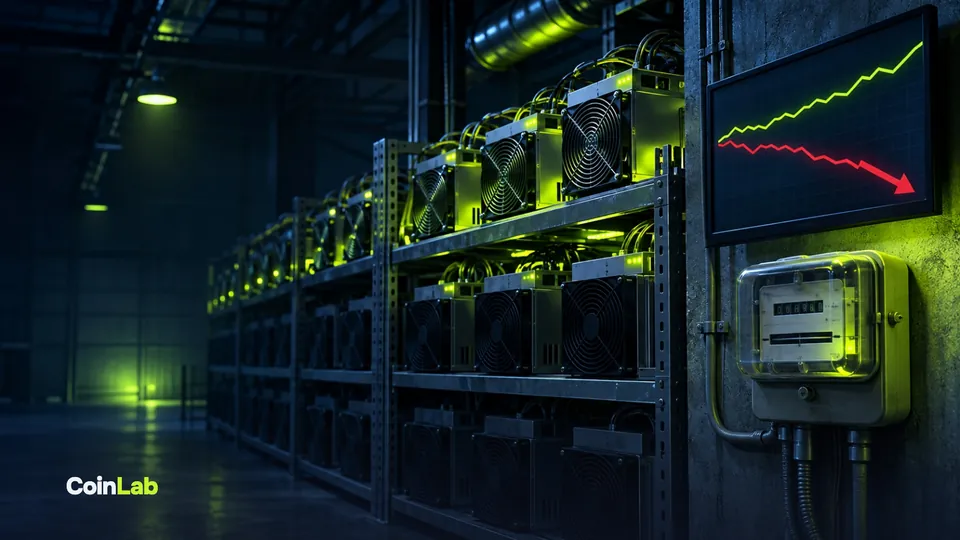
Bitcoin mining cost is what a miner spends to produce 1 BTC: electricity, hardware, hosting, staff and debt. The biggest variable is power price and ASIC efficiency: as of November 14, 2026, the electricity alone for one coin ranges from about $27,500 on a latest-generation machine paying $0.04 per kWh to about $120,000 on an older rig paying $0.08. When the price drops below what weaker operators spend, miner capitulation begins: machines get switched off, coin reserves get sold, and network hashrate and difficulty fall.
What goes into the cost of mining one bitcoin
Mining means grinding through hashes for the right to add a block and collect the reward (see how bitcoin mining works). A miner's expenses fall into two buckets.
Cash costs are the bills that arrive every month: - electricity, usually the largest line item; - hosting or site lease, cooling and repairs; - payroll, insurance and overhead.
All-in cost adds what monthly bills don't show: - ASIC depreciation, since machines go obsolete within a few years as more efficient models ship; - interest on debt and capital spent on new sites; - in public company reports, stock-based compensation too.
That's why the same company can look profitable on a cash basis and lose money on an all-in basis. Whenever a headline quotes "bitcoin's production cost," check which of the two it means.
How to estimate bitcoin mining cost yourself
Miner revenue is measured with hashprice: dollars earned per day by 1 PH/s (petahash per second) of hashing power. It depends on three inputs: the bitcoin price, the block reward (a 3.125 BTC subsidy since the 2024 halving plus fees) and network difficulty. Higher difficulty means fewer coins for the same hashpower.
The math in four steps:
- Work out how much BTC 1 TH/s earns per day at current difficulty: 86,400 × block reward / (difficulty × 2³²) × 10¹².
- Take the machine's efficiency in joules per terahash (J/TH) from its spec sheet.
- Convert to daily energy use per TH/s: J/TH × 24 / 1,000 = kWh.
- Multiply by your power rate and divide by the output from step 1. That's your electricity cost per BTC.
Add depreciation and other expenses, and you get the all-in cost for a specific operation.
What it looks like on November 14, 2026
On November 14, 2026, the network retargeted at block 975,744 and difficulty fell 9.13% to 134.8 trillion, according to mempool.space. That's the third cut of more than 9% in 2026, after −11.16% on February 7 and −10.09% on June 14, and difficulty now sits 13.6% below its peak of 156 trillion set on October 29, 2025. Average hashrate is around 910 EH/s (see our Numbers block).
Over the last 144 blocks, miners collected 454.4 BTC, of which only 4.4 BTC, under 1%, came from fees (mempool.space). At the new difficulty, 1 PH/s earns about 0.00047 BTC a day. With bitcoin at $67,165 as of 3:00 AM ET on November 14 (our data, market pulse), hashprice comes to roughly $31.6 per PH/s per day.
Electricity cost per BTC under those conditions (our calculation):
| Machine and efficiency | $0.04/kWh | $0.06/kWh | $0.08/kWh |
|---|---|---|---|
| Antminer S21 XP — 13.5 J/TH | $27,500 | $41,300 | $55,000 |
| Antminer S21 — 17.5 J/TH | $35,700 | $53,500 | $71,400 |
| Antminer S19j Pro — 29.5 J/TH | $60,100 | $90,200 | $120,300 |
Efficiency figures come from Hashrate Index's S21-series overview and its S19j Pro spec page. The takeaway: an older rig on an average power contract now spends more on electricity than the coin is worth, while a new machine on cheap power keeps a cushion.
What public miners report
CoinShares publishes a regular industry estimate. Its Q2 2026 mining report put the weighted average cash cost to produce 1 BTC at public miners at about $75,500, excluding depreciation, while bitcoin closed June at $58,400, The Block reported. Monthly average hashprice hit an all-time low of $27.70 per PH/s per day in June; after bitcoin recovered to about $77,000, it climbed to roughly $38 and most operators moved back above cash breakeven.
Individual companies vary. MARA reported a cost of $27.7 per petahash per day in Q2 2026, mined 2,422 BTC, sold 2,213 BTC and saw its holdings shrink to 35,577 BTC (The Block). Compare that with a $31.6 hashprice on November 14: even a large miner's margin is a few dollars per petahash. Many firms are closing the gap by turning sites into AI data centers, a shift covered in our guide to companies holding bitcoin.
What miner capitulation is and how to spot it
Capitulation is a stretch when mining stops paying for a meaningful share of the network, so operators switch off hardware or sell their stacked coins to cover bills. Signs to watch:
- Hashrate falls for weeks and difficulty drops at retargets. On July 31, 2026, Look Into Bitcoin noted difficulty was 19.9% below its peak, the third-deepest drawdown since ASICs replaced GPUs.
- Hash Ribbons, Charles Edwards's indicator at Capriole, compares 30- and 60-day moving averages of hashrate. When the short one drops below the long one, miners are capitulating; the recovery signal is the cross back up.
- Hashprice near record lows and falling miner revenue in dollar terms.
- Selling from miner wallets and shrinking BTC holdings in company reports.
As of November 14, 2026, our calculation from mempool.space daily data shows the 30-day hashrate average (about 1,012 EH/s) still above the 60-day one (about 992 EH/s): Hash Ribbons haven't formally flipped, even though difficulty just fell 9%. The indicator lags and daily hashrate estimates are noisy, so read the trend, not a single print. For the metrics themselves, see bitcoin hashrate and difficulty.
Is mining cost a price floor?
A popular idea says bitcoin can't trade below its production cost for long. It can, and 2026 proved it: per CoinShares, the price at the end of Q2 ($58,400) was below public miners' average cash cost ($75,500). The reason is built into the protocol. Production cost isn't fixed. When weak miners leave, difficulty adjusts down, survivors earn more coins for the same hashpower, and cost follows price lower. That self-adjustment is part of the design in Satoshi Nakamoto's white paper.
The historical link is different. Capriole's backtest shows that buying after Hash Ribbons signaled the end of capitulation landed close to past cycle lows, but that's hindsight, not a guarantee. And 2026 has been unusual: Look Into Bitcoin points out that miner stocks rallied while bitcoin fell, as investors priced them as future AI infrastructure rather than coin producers.
Common mistakes
- Mixing up cash and all-in cost. The gap can be tens of percent, because ASIC depreciation is large.
- Using one number for the whole network. An S21 XP on $0.04 power and an S19j Pro on $0.08 differ by a factor of four.
- Ignoring difficulty. The same math gives a different answer after each retarget, so rerun it every two weeks.
- Treating cost as a hard floor. Price can sit below average cost for months, and cost then drops on its own.
- Calling capitulation from one day of hashrate. Daily estimates are noisy; use multi-week averages.
FAQ
How much does it cost to mine 1 bitcoin? It depends on the machine and the power rate. As of November 14, 2026, electricity alone runs from about $27,500 to $120,000 per coin (see the table); CoinShares put public miners' average cash cost at about $75,500 in Q2 2026.
What is hashprice? Dollar revenue per 1 PH/s of hashpower per day. About $31.6 on November 14, 2026, by our calculation.
Is miner capitulation a buy signal? Historically, the end of capitulation often came near market lows, but that's an observation about the past, not a rule. The indicators lag and can misfire.
What happens to miners after the next halving? The subsidy drops to 1.5625 BTC; by our data, the halving is about 74,000 blocks away (roughly April 2028). Without higher prices or fees, only the most efficient machines on cheap power will stay profitable. Track the network and price on our bitcoin page.
This is not investment advice.

Comments